mDuo13
Thoughts, Words, WorksPlaying Games Well: 7 Wonders
7 Wonders is a wonderful game, a civilization builder set in ancient times powered by a drafting mechanic that's elegant but extremely deep. Best of all, it plays quickly with anywhere from three to a whopping seven players, thanks to the powers of simultaneous play. The expansions, Leaders and Cities, and the Wonder Pack mini-expansion, add more variety while not changing the game much — something that sits well with me since it keeps the game fresh but keeps the burden on new players relatively low. It also means that the expansions haven't (thus far) revolutionized the game strategy, which is nice for experienced players and strategy bloggers (ha!). Hence, it's something I've played plenty, and I'm excited to discuss my strategies for the game and thoughts on how to play well. For clarity's sake: I will not be addressing the 2-player variant, nor the team variant introduced by the Cities expansion, since I have not played enough of either.
Playing Games Well: Principles
I play a lot of board games, especially Eurogames, and one thing that grinds my gears (no, not Tzolk'in gears) is that too many people don't know how to make effective decisions for playing to win. That's why I'm starting this series on how to play board games (and card games) well. In doing so, I hope to pin down and share some of the patterns that help me decide what to do. There's always the possibility that this will just lead to more analysis paralysis as people consider every move thoroughly, but that's a risk I'm willing to take.
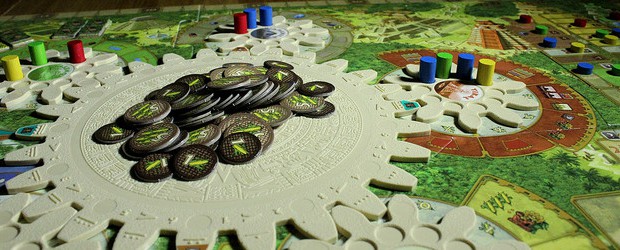
For the first installment, I'm going to cover basic principles and ideas. Not all of these will apply to every game, but I'll try to strike a balance where they're specific enough to use in some games, but not limited to a single game.
Introducing Technika ScoreSeeker

Today I introduce my first Greasemonkey script for public consumption: Technika ScoreSeeker. This script is meant for users of DJ Max Technika 3's International version website, djmaxcrew.com. It provides a new "All" page in the POP Mixing Performance area, displaying all1 your results (NM, HD, and MX charts) on one page, in a sortable table, with scores highlighted according to how well you did.
Reaching for the Stars

Note: This post retreads some of the same thoughts as an earlier one in a slightly different light.
I've passingly mentioned that I'm currently playing StarCraft II. But I don't mean that in the same way I meant it when, for example, I said I was playing Metroid: Other M recently. No, I'm playing StarCraft II in a sense that perhaps more closely resembles if an athlete were playing football this fall, or a more intellectually-inclined individual might say he were playing chess. In other words, I'm not approaching it as a work to be completed, I'm approaching it as an activity to compete in and get better at. The distinction may seem academic, but there's a pretty different attitude involved and, to be honest, it's taken me by surprise that I'm interested in this sort of thing.
Time Journeys
At work, a few developers recommended Flash Switcher, a Firefox extension for testing with different Flash versions easily. And it occurred to me: this extension is hosted on "sephiroth.it". You know what that means to me? It means that the generation of people who are out there doing web development and making games right now is the generation for whom Final Fantasy VII was a defining gaming experience.
God help us.
Not entirely an Other M

I recently acquired and played Metroid: Other M. (Aside: you have no idea how weird it feels to type that in <em> tags.) When I first heard that Team Ninja was going to be making the next Metroid game, and I saw the trailers, I was worried. I've blogged before about the gradual corruption of the Metroid formula and all signs indicated that this game would accelerate that loathsome trend. Yet, being as I did have an interest in how the series' plot develops, I wondered if Other M might be an enjoyable game in its own right. Having finished it, my relationship with the game is a bit hard to describe in short, if you can forgive my longwindedness, please read on.